"Every single nest, roost, and feeding tree we have confirmed has either been planted or facilitated by a person," Texas A&M biology professor Donald J. Brightsmith told the American Bird Conservancy in 2025. He was talking about the Red-crowned Parrots of the Lower Rio Grande Valley. One of their four big roosts sits in Harlingen.
This week visitors from across the country are in town for the Rio Grande Valley Birding Festival, running November 11 through 15, 2026, at the Harlingen Convention Center on Harlingen Heights Drive. Some of them flew in to see birds that spend every evening over Harlingen's own side streets.
A Field Trip Built Around a Daily Commute
Wednesday afternoon's festival schedule included a two-hour outing called Parrot Palooza!, and the festival agenda listed it at full capacity. The agenda calls it "urban commando" birding. Three or four unmarked white vans drive through Harlingen neighborhoods "at ice cream truck speed," listening for flocks and "occasionally drawing the curious attention of local residents." Guides Terrilyn Alaniz and Amy Kearns lead it, and the van driving stays inside Harlingen city limits the whole time.
The trip follows the birds' evening schedule. Early in the evening, the vans spread out to look for Green Parakeets, which the agenda says are "widely scattered throughout Harlingen." Then everyone turns to the main flock, a mixed group of parrots "upwards of 200 birds" that gathers and feeds at pre-roost sites in North Harlingen. The vans regroup in "whatever random suburban neighborhood the mega-flock picked to roost in that night." The trip lists Red-crowned Parrot, Green Parakeet, Red-lored Parrot, Lilac-crowned Parrot and Yellow-headed Parrot as its highlights.
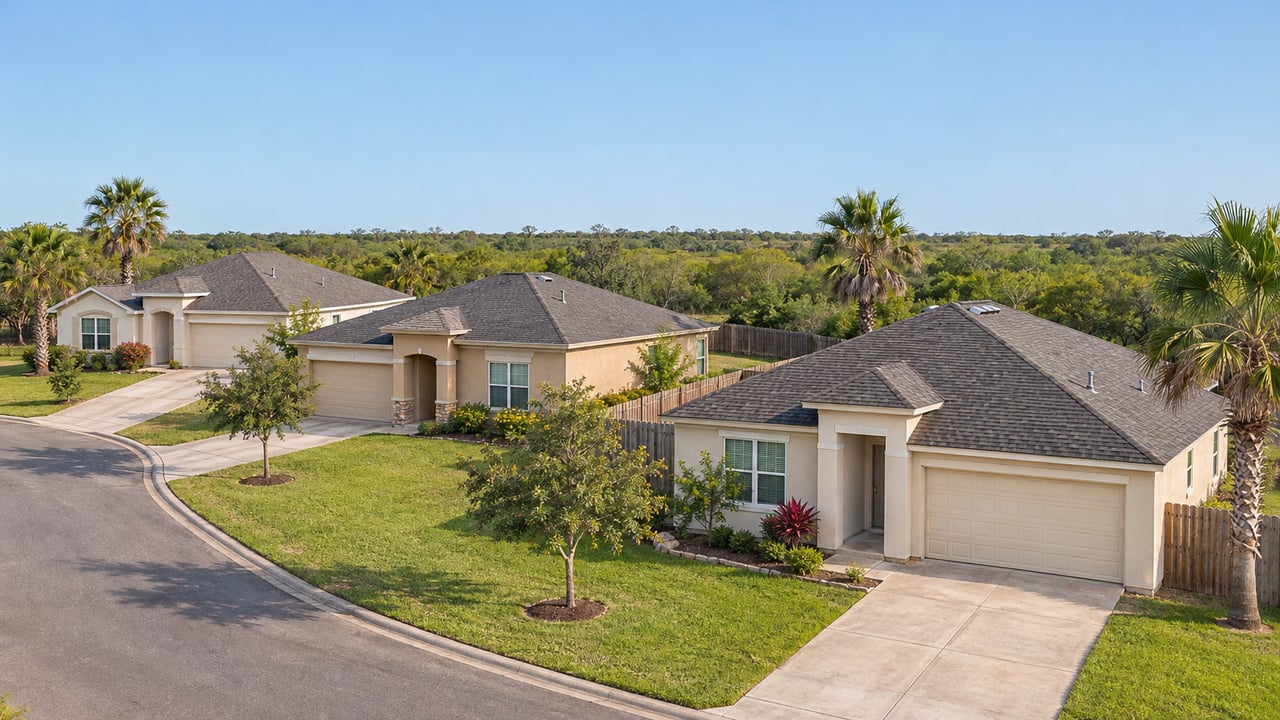
So the festival's signature urban trip ends on an ordinary residential street. The visitors paid to stand there. The people who live there were already home.
Every Tree in the Story Was Planted by Someone
The flock settles in Harlingen neighborhoods because the neighborhoods are its habitat. In the wild, the Red-crowned Parrot lives in scrub forest within a small range in northeastern Mexico. In the Valley, according to the American Bird Conservancy, "suburban yards, shopping centers, and a city park" now shelter a population based in four cities: Brownsville, Harlingen, McAllen and Weslaco.
Simon Kiacz has studied these birds since 2016 as part of the Tejano Parrot Project at Texas A&M. He put it plainly to the same outlet: "It's clear that these parrots want what the people want." TPWD wildlife biologist Tony Henehan told ABC he knew of no evidence of flocks living outside the urban edge. The yard trees, street trees and shopping-center plantings across Harlingen are the reason the birds stay in town.
Those trees matter well beyond Harlingen. The International Union for Conservation of Nature lists the Red-crowned Parrot as Endangered. ABC reports that the species has vanished from 50 to 85 percent of its original range and that its population is down an estimated 95 percent.
What the Counts Say About the Flock Overhead
The Valley's parrots get counted on a schedule, not by guesswork. Henehan coordinates quarterly roost counts across the Lower Rio Grande Valley. Most of the counting is done by local volunteers recruited through Arroyo Colorado Audubon and the Texas Master Naturalists.
Here is what those counts have produced:
- 2016 to 2019: A study in Bird Conservation International reported 412 surveys at known Valley roosts between January 2016 and April 2019. It put the minimum population at about 680 birds.
- As of September 2025: ABC put the Valley population at about 700 birds. It had held steady for the previous three to five years after rising for decades.
- Nationwide, as of 2025: ABC estimated about 4,700 Red-crowned Parrots in the United States, compared with 2,000 to 4,300 adults left in the wild in Mexico.
Set those figures side by side and the roost over a North Harlingen street becomes one of the four pillars of a satellite population. The study's authors call that population "an important reservoir for this endangered species."
Nobody knows exactly how the parrots got here. Texas Monthly reported in July 2025 that birds flying north from Mexico on their own and escaped or released pets are both plausible sources, and it cited TPWD ornithologist Tania Homayoun. ABC says the share from each source can't be determined. On the federal side, the U.S. Fish and Wildlife Service's species page shows its latest action as an April 4, 2019 finding that listing the species was "Not Warranted."
How a Roost Night Unfolds
ABC says the four big South Texas roosts are in use much of the year and thin out during nesting season. A 2023 study of Valley roosts adds that the large mixed-age gatherings build through fall and winter, then shrink and break into smaller flocks as spring nesting gets closer. Mid-November falls in the building season.
Putting the festival agenda and the researchers' accounts together, an evening goes in this order:
- Early evening: Green Parakeet flocks spread across Harlingen. The festival goes after them first because they show up before the parrots gather.
- Late afternoon into dusk: The mixed parrot flock gathers and feeds at pre-roost sites in North Harlingen.
- Dusk: The birds gather "in noisy congregations," in ABC's words.
- Nightfall: They settle quietly onto their roost perches.
- Just before sunrise: The same thing happens in reverse.
Kiacz described the quiet that comes after the noise:
"People will roll right up to these birds and park their cars, or the pizza guy stops by, and they have no idea there are 200 birds right above their heads."
That quote comes from ABC's 2025 report. The same article says the Brownsville roost stays mostly in one place, while the other three roosts, Harlingen's included, move from time to time. So the "random suburban neighborhood" line in the festival agenda is accurate.
Where Harlingen's Own Guide Points You
Because the roost moves, published spots tell you roughly where to go, not exactly where the birds will be. Start with the city's Harlingen bird guide, published in August 2025. It calls the city "home to a steadily growing Red-crowned Parrot roost" that gathers "by the hundreds," and says to look in the neighborhoods next to North 7th Street.
- North 7th Street area. eBird keeps a hotspot named Harlingen—7th & Vinson Parrot Roost, with Red-crowned Amazon and Green Parakeet among the birds recorded there. Recent checklists on that page give a sense of where the flock has been showing up.
- Harlingen City Lake, 410 '76 Drive. It sits across from the Harlingen Public Library. Visit Harlingen tells birders to check the dense native trees along the neighborhoods north of the lake and the pocket park east of '76 Drive for "rowdy parrots and parakeets that feed in the area." A paved sidewalk runs around three-quarters of the lake. There are no facilities, and parking is on the street.
- Hugh Ramsey Nature Park, 1001 South Loop 499. Texas Monthly lists it as a Harlingen hotspot for Red-crowned Parrots. It covers 55 acres with restrooms, a pavilion, photo blinds and a hummingbird garden that draws Buff-bellied Hummingbirds all year.
The roost forms over streets where people live. Watching from a public sidewalk or a parked car fits a flock that has done well, as Kiacz told ABC, because people let it be. He said the residents who have the birds nesting and roosting in their yards "have a really strong connection with them."
The Rest of Festival Week, Free
The parrot trip costs extra on top of registration. Some of the festival is free and open to everyone. The 2026 festival page lists the Birders Bazaar, kids' activities and the festival store as free to the public.
Bazaar hours at the Harlingen Convention Center, per the festival FAQ:
- Thursday, November 12, and Friday, November 13: noon to 6 p.m.
- Saturday, November 14: 10 a.m. to 6 p.m.
- Sunday, November 15: 11 a.m. to 3 p.m.
Saturday's Bazaar closes at 6 p.m., so you can walk the booths and then drive north toward 7th Street as the light fades. For a daytime walk, the Harlingen Thicket at 770 East Taft Avenue is open sunrise to sunset. Its 40 acres of Tamaulipan brush have trails down to the Arroyo Colorado. It and Hugh Ramsey make up the Harlingen Arroyo Colorado World Birding Center.
Harlingen is full of moments like this one, where something visitors pay to see turns out to be part of an ordinary evening at home. At Blue Heron Realty, we pay attention to those details because they're what makes a street feel like home. If the North Harlingen parrots are part of why you love where you live, or why you'd like to live closer to them, Maggie and our bilingual team would love to talk. Make every move the right one.